Elementor 3.34 continues the evolution of Editor V4 by expanding with new composable layout capabilities, introducing the first layer of interactions, and refining core systems to improve consistency, predictability, and extensibility.
This release brings additional foundational UI patterns while strengthening the underlying architecture that supports CSS-first styling and class-driven workflows. All features described below apply to Editor V4, which remains in Alpha and is still under active development.
Editor V4 – Atomic Editor
Editor V4 represents the ongoing re-architecture of Elementor around atomic design principles, explicit structure, and predictable styling behavior. Rather than abstracting layout and behavior behind widgets, V4 exposes composition through Atomic Elements, Global Classes, and a clearer separation between structure, styling, and behavior.
The features introduced in 3.34 build on this foundation and reflect the direction of the editor as it moves toward a fully atomic, extensible system. As Editor V4 is still in Alpha, these capabilities are experimental and may change as feedback is collected and the system evolves.
Nested Tabs
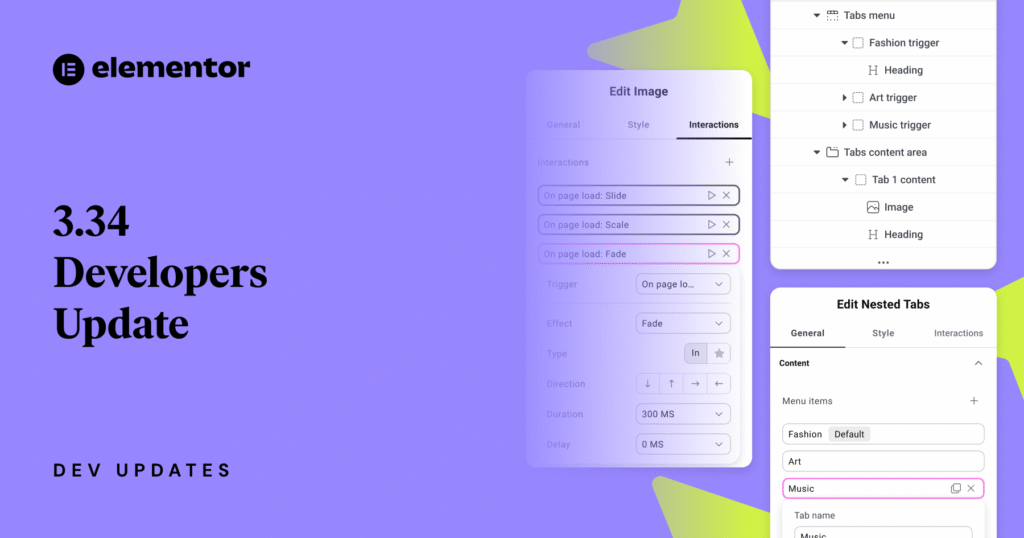
Elementor 3.34 introduces Nested Tabs as a fully atomic replacement for preset-based tab widgets, allowing developers to build tab interfaces using explicit, composable Atomic Elements. Tabs are exposed as a clear structural hierarchy that separates triggers, content areas, and panels, enabling granular control over layout and styling.
Because Nested Tabs are built entirely on the atomic styling system, any part of the structure can be styled with Global Classes, nested with other Atomic Elements, and understood directly through the Structure panel. This release also adds a dedicated Selected state for Tab Triggers, allowing active tab styling using standard atomic controls without custom CSS or JavaScript.
Entrance Interactions
Elementor 3.34 introduces Entrance Interactions, the first implementation of the new atomic Interactions system, focused on lightweight, performance-minded motion. Atomic Elements now include a dedicated Interactions tab that separates behavioral logic from structure and styling, establishing a clear foundation for future interaction capabilities.
Entrance Interactions currently support animations triggered on page load or when elements enter the viewport, with motion configured through granular properties such as effect type, direction, duration, and delay. Multiple entrance effects can be layered on a single element, and each interaction includes a preview control to replay animations directly on the canvas.
Additional Editor V4 Improvements
This release includes several foundational improvements that increase consistency across the editor. Atomic Elements are now automatically wrapped in an Atomic Flexbox container, replacing the legacy V3 container element and resulting in cleaner markup, more predictable layout behavior, and a fully atomic structure from insertion onward.
Display Conditions are now supported directly in the General tab of Atomic Elements, providing a unified workflow for controlling visibility. Custom CSS now supports media queries in Desktop mode, enabling advanced breakpoint logic. The Paragraph Element has been extended with inline span support for more refined semantic text styling.
Accessibility Improvements
Elementor 3.34 continues to refine accessibility across widgets, focusing on reducing noise in assistive technologies and aligning output with accessibility best practices.
Flip Box: Decorative Icons Hidden from Screen Readers
In this release, decorative icons in the Flip Box widget have been removed from the accessibility tree, preventing them from being announced by screen readers as images. These icons do not convey semantic meaning and are intended purely for visual decoration, and exposing them previously caused unnecessary verbosity for screen reader users.
With this change, Flip Box output is now consistent with other widgets, where decorative visuals are excluded by default, resulting in cleaner, more focused navigation for users relying on assistive technologies.
Additional Changes and Fixes
Beyond the headline features, Elementor 3.34 includes a broad set of refinements and fixes across both the free and Pro versions. These updates improve frontend output consistency, refine editor controls and UI behavior, expand support for CSS logical properties and RTL rendering, extend Dynamic Tags integration, and address issues related to transforms, hover states, cache regeneration, localization, and PHP 8.4 compatibility.
Together, all these changes further stabilize the atomic editor and reduce friction when building with Editor V4.
To Conclude
Editor V4 remains under active development, and the features introduced in Elementor 3.34 should be treated as experimental and not production-ready. Markup, APIs, and behavior may evolve as development continues, and early testing and feedback play a key role in shaping future iterations of atomic elements, interactions, and global styling systems.
Elementor 3.34 represents another step toward a fully atomic, CSS-first editor, strengthening the foundation for what Editor V4 will become.
